
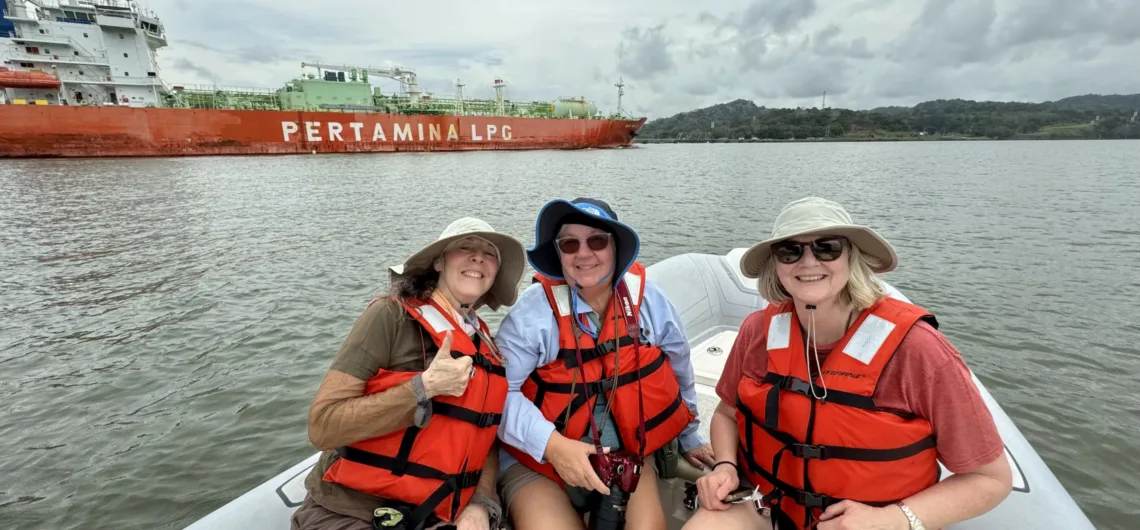
Cover photo: Mona Clayton (left), Debbie Smith (center), and Janice Mowry (right) bird from a small boat along the Panama Canal during their February 2025 trip to Panama. Photo courtesy of Mona Clayton.
Text by Mona Clayton
After months of medical appointments — with more still ahead — I needed something uncomplicated on the horizon. I hadn’t seen many birding friends, and driving long distances still felt uncertain. Even familiar motions, like bringing a bird into the center of my binoculars, took more effort.
What hadn’t changed was the way travel, and time with friends, made me feel most alive.
Planning a February 2025 birding trip gave me something solid to hold onto. I wasn’t looking for extremes or endurance birding. I wanted a place where logistics faded into the background with lots of time outside.
Reasonable distances. No long transport rides. One primary base. Several days with two friends, me, and a guide. Knowledgeable guides who knew birds and butterflies. Nutritious food. And birding that didn’t depend on constant playback or rushing from one sighting to the next.
Those criteria narrowed the world quickly. Panama rose to the top — a country I had passed through many times but never truly visited.
WHY PANAMA
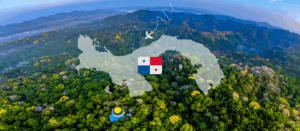
Panama makes sense for birding in ways that are both obvious and surprising. More than 1,000 bird species have been recorded in a country smaller than my state, Indiana, thanks to its position as a land bridge between North and South America. That geography compresses a wide range of habitats — lowland rainforest, foothills, cloud forest, wetlands, open country, and coast — into relatively short distances.
What also stood out was how accessible that diversity felt. Urban and near-urban birding was productive, and moving from one habitat to another did not require long travel days in transportation. With all meals provided, there was no need to wonder when the next meal would happen or what would be available — a small detail that made the days easier and more relaxed.
Panama is convenient for travelers from the United States. The country operates on Eastern Standard Time year-round. The U.S. dollar is one of Panama’s two currencies, together with the Panamanian balboa, which has exactly the same value as dollars, simplifying transactions. It is possible to fly out in the morning from many U.S. cities and arrive in Panama by mid-afternoon, ready to begin the trip rather than recover from it.
TRAVELING TOGETHER
I traveled with two friends: Debbie Smith, a long-time friend, and Janice Mowry, a newer Birdher connection. Neither had traveled south of Mexico before, and neither had been on an international birding trip. This mattered to me.
I wanted the experience to feel welcoming and doable — not competitive, not rushed, and not overwhelming. From the beginning, the pace set at the Canopy Lodge made that possible. We birded together and had time to linger when something caught our attention.
Just the pace I was looking for in the midst of recovery.
Watching Debbie and Janice experience tropical birding for the first time — the color, the sound, the sheer abundance — became one of the quiet joys of the trip.
PANAMA CANAL
We first enjoyed a few days near the Panama Canal before arranging a pickup with the Canopy Lodge from our lodging. Looking out a fifth-floor window, we saw a herd of capybara, grazing near the water. Welcome to Panama!
Birding at the nearby Clayton Pond (couldn’t resist with the name!) revealed a Rufescent Tiger-Heron along the bank.
Don’t miss the Panama Canal Visitor’s Center if you are in the area. It was awe-inspiring to see vessels of all kinds — from a tall ship to a massive container ship stacked high like Legos — making their way through the locks.
FOOTHILLS, FORESTS, AND FEEDERS
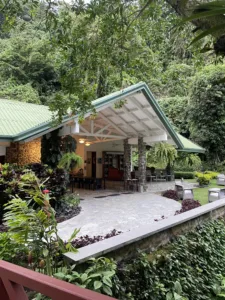
Canopy Lodge sits within the volcanic caldera of El Valle de Antón, with varied habitat all close at hand.
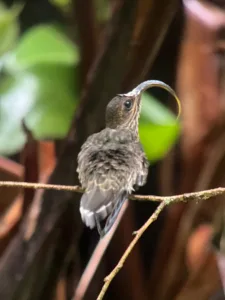
Mornings began watching and listening to birds at the feeders, adjacent to breakfast seating. The Canopy Lodge gardens were a delight from the moment we arrived. Gray-headed Chachalaca and White-tipped Dove were familiar, joined by Snowy-bellied and Rufous-tailed Hummingbirds. During a rainy afternoon of settling in, the unforgettable White-tipped Sicklebill appeared, bringing with it a heavy dose of joy. Each day seemed to eclipse the one before, filled with wonder, awe, and gratitude.
The property is extensive and inviting to explore. Trails, roadsides, gardens, and the areas surrounding the zipline and natural pools provided opportunities to continue our discoveries with Tino Sánchez, one of our amazing guides. We were rewarded with memorable sightings, including a pair of Mottled Owls — be ready for the trek — and a colorful Graceful Black-throated Trogon.
WHEN BUTTERFLIES TOOK OVER
One day, birds gave way — briefly — to butterflies. The diversity was striking, and what made it especially enjoyable was knowing what we were observing. Our guides identified butterflies with the same ease they brought to birds, turning what could have been a colorful blur into something grounded and memorable.
Having names and stories for those moments slowed the day in a good way, and reminded us that paying attention isn’t limited to feathers.
FAMILIAR BIRDS, NEW CONTEXT
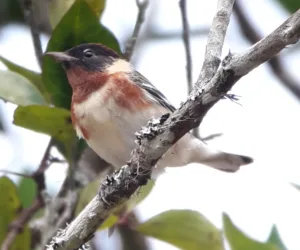
A rewarding aspect of birding in Panama was encountering familiar birds in an entirely different context, specifically warblers. Golden-winged, Bay-breasted, Chestnut-sided, and Tennessee Warblers appeared regularly, among others. Seeing familiar warblers on wintering grounds in Panama provided a broader understanding of the extensive annual journeys of these tiny creatures. We eagerly anticipate their arrival each spring.
Beyond those familiar species, color filled the canopy edges. Crimson-backed, Silver-throated, Golden-hooded, Bay-headed, Emerald, and Blue-gray Tanagers became identifiable over the days. Euphonias and honeycreepers added flashes of movement at mid-levels. The diversity was constant, and never overwhelming.
WETLANDS AND OPEN COUNTRY
A late-February day along the coast expanded the trip again. Wetlands, shoreline, and open country produced an astonishing variety of birds in a single day — jacanas walking delicately across floating vegetation, lapwings calling from open ground, and large flocks of Glossy Ibises feeding together.
Raptors were plentiful, including Savanna Hawk, Aplomado Falcon, Crested and Yellow-headed Caracaras, and many vultures. Along the coast, Willets and Whimbrel rounded out the scene.
Panama’s geography — narrow, varied, and compressed — makes these shifts feel effortless.
STAYING ON
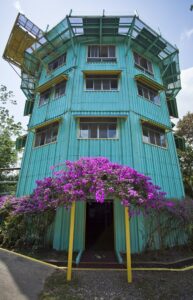
While we were at the Lodge, a rare cancellation opened three nights at the Canopy Tower. The timing worked. Debbie and Janice returned home, and I stayed, moving to a new ecosystem, the lowlands.
Under different circumstances, that choice may have felt daunting. Coming off a year shaped by more than one hundred healthcare encounters, I was grateful to re-engage my solo traveler skills.
Birding did not require rushing. From the observation deck at the Tower, birds appeared: toucans in the canopy, flycatchers calling, Red-lored Amazons flying by. Outings along Pipeline Road and nearby ponds allowed everyone to see each bird species. Little Tinamou, Golden-collared Manakin, Red-capped Manakin, Whooping Motmot, White-whiskered Puffbird, and Green Shrike-Vireo appeared in their own time.
I wasn’t counting species or minutes. I was simply present.
LOOKING BACK
By the end of the trip, I had recorded 291 species in Panama. The number itself matters less than how those birds were encountered. Nothing felt rushed, and nothing was framed as “____________ saw it.” Each species on my eBird list was something I had the time and space to observe myself.
That pace — unhurried, attentive, and generous — reflects the style of birding encouraged at the Canopy Family.
I returned home with gratitude — for the birds, the places, and the people who made the trip possible, especially Debbie and Janice, whose support and companionship were immeasurable. I also returned with something quieter and just as important: renewed confidence in my ability to move through the world again, at my own pace.
My Panama trip report on eBird:
https://ebird.org/tripreport/345222
Mona Clayton, aka Rookie Birdher, is a Birdher, traveler, and Certified Access Birding Outing Leader. Through Rookie Birdher, she encourages people of all ages and abilities to discover birds and nature at their own pace. She is also a member of the board of directors of Indiana Audubon.
Adapted from an article originally published by Indiana Audubon in May 2026.