
By: Raúl Arias de Para
When it appeared in 1976, the book The Birds of Panama by Robert S. Ridgely represented a turning point in the world of birding. Earlier works on birds had been written mainly for professional ornithologists. Ridgely’s guide was different. It was written for the growing community of amateur naturalists, people who simply loved watching birds. In that sense, The Birds of Panama became one of the pioneers of modern field guides, a model that would later be followed around the world.
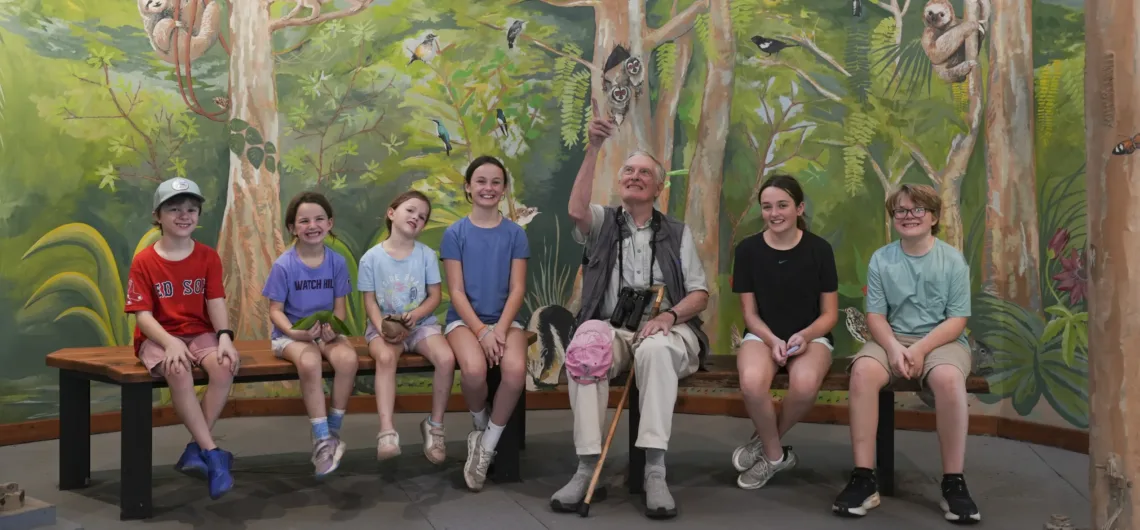
In February 2026, Bob travelled to Panama to celebrate the 50th anniversary of his pioneering book. This visit was especially meaningful to me because he had played an important role in the early days of the transformation of the Canopy Tower from a radar installation into a birding lodge.
I first met him in 1998 while birding in Summit Gardens, the municipal park not far from the Tower. Someone pointed discreetly to a gentleman nearby and said, “That is Robert Ridgely, the author of The Birds of Panama.” I had never met him before. So, I walked up to him with the classic phrase: “Allow me to introduce myself.” I told him that I was in the process of transforming an old radar tower in the forest nearby into a lodge for birdwatchers. Then I asked him a simple question: “Would you like to see it?” He said yes. That very same day we drove to the Tower. At the time it was still a strange structure rising above the forest canopy, a relic of the Cold War that I hoped might become something entirely different. Bob immediately loved the idea. It was, quite literally, love at first sight.
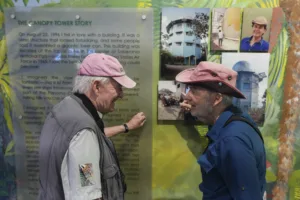
As we talked about the project, Bob offered me one piece of advice that turned out to be extremely important. My original concept had been to create something like a hostel. Bob gently explained that birdwatchers tend to be older travelers who value comfort and privacy. They prefer their own room and their own bathroom. At the time I knew very little about birding lodges. His suggestion made perfect sense, and I changed the concept to an eco-lodge. Looking back, that chance encounter in Summit Gardens helped shape the Tower as it exists today.
Seeing Bob again many years later, as we celebrated the 50th anniversary of his remarkable book, felt like closing a circle in the story of birding in Panama.

Historical Context
Dr. Robert S. Ridgely is one of the most influential ornithologists and field‑guide authors of the Neotropics. His book, The Birds of Panama (1976), helped transform birdwatching in the tropics by providing one of the earliest modern field guides designed for amateur birders rather than academic specialists.
In addition to this pioneering work, Ridgely later produced several other major publications on Neotropical birds. Among the most important are The Birds of South America (1989–1994), written with illustrator Guy Tudor, and The Birds of Ecuador (2001), written with Paul Greenfield. These works became essential references for birders and ornithologists throughout tropical America and helped shape modern birdwatching in the Neotropics.
Beyond his books, Ridgely has also played a major role in bird conservation. He served as president of the Rainforest Trust and helped found Fundación Jocotoco in Ecuador, an organization that has established and manages several important bird reserves to protect endangered species and their habitats.
In Panama, he founded, together with the Eisenmann Family and Raúl Arias de Para, the Fundación Avifauna Eugene Eisenmann.
Selected Books by Robert S. Ridgely
- The Birds of Panama (1976)
- The Birds of South America, Vol. 1: The Oscine Passerines (1989) – with Guy Tudor
- The Birds of South America, Vol. 2: The Suboscine Passerines (1994) – with Guy Tudor
- The Birds of Ecuador (two volumes) (2001) – with Paul Greenfield
- The Birds of Ecuador (2006) – with Paul Greenfield
- Hummingbirds of Ecuador (2011)